From Observation to Abstraction
Juan Rivera didn’t start out chasing the abstract. His early days as a painter were grounded in traditional realism quiet landscapes, still lifes, portraits with sharp eyed attention to detail. He studied light, texture, and form with surgical precision. But he wasn’t just copying what he saw. Even then, his realism held a certain tension, like he was cracking something open beneath the surface of ordinary scenes.
The shift didn’t happen overnight. Several personal milestones losing his father, returning to his childhood neighborhood in San Fernando, and delving deeper into his raíces reshaped what he wanted from the canvas. The clean lines of realism felt too tidy, too boxed in for what he needed to express. That’s when form began to loosen. Color took the lead. Shape became feeling.
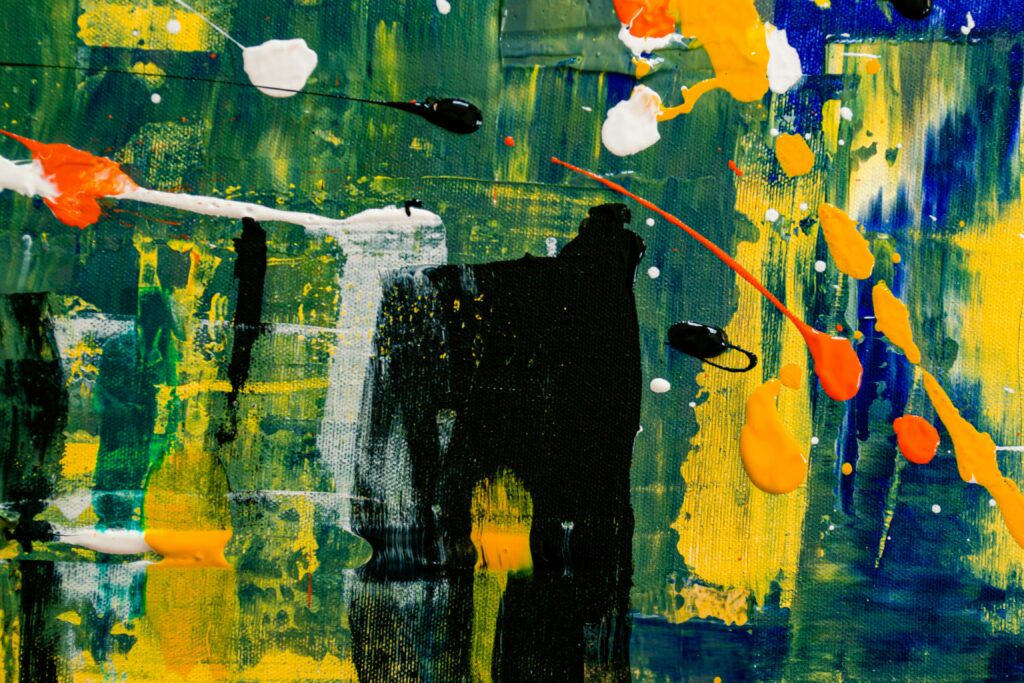
Through abstraction, Rivera found space to say what words and representational images couldn’t. Grief, pride, resilience all the things knotted up in his experience as a Mexican American started pouring onto canvas in bold, unspoken ways. His work doesn’t scream identity; instead, it pulses with it. Warm terracotta. Indigo shadows. Repeated motifs inspired by Aztec iconography but washed through a personal lens. This isn’t nationalism. It’s memory fragmented, reassembled, and reimagined through a visual language entirely his own.
Emotion as Medium
Rivera doesn’t paint from sketches. He paints from memory sometimes fragmented, sometimes overwhelming. His process begins quietly, almost like waiting. He sits with an emotion a loss, a moment of joy, a childhood scent and lets it steep. From there, the work emerges not as a picture of the feeling, but as its residue. A smear of ochre for the ache of missing his grandmother. A sudden horizon line when he remembers her laugh.
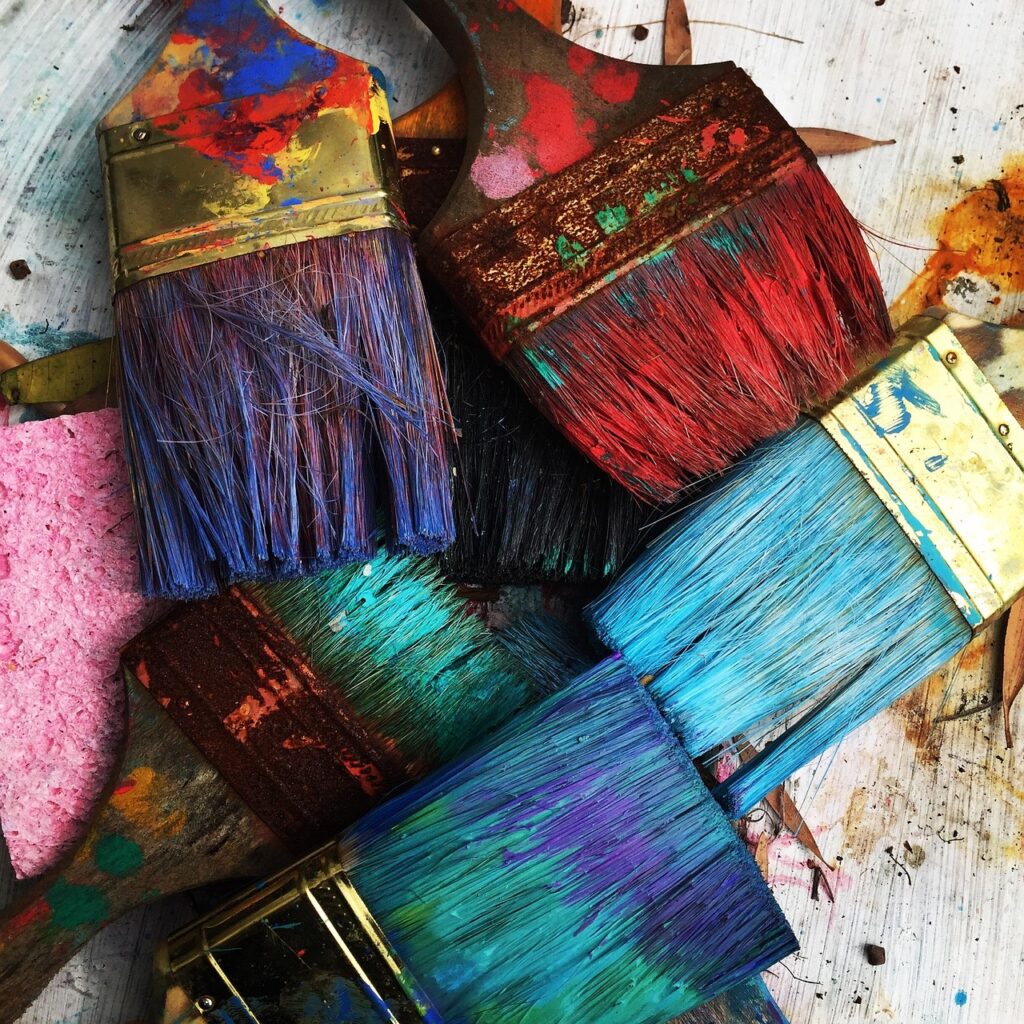
The materials he uses aren’t just practical they’re emotional triggers. Heavy bodied acrylics for immediacy. Raw linen for transparency and tension. He favors colors that shift under different light: deep blues that collapse into purple, or bright reds stained with black. These aren’t random. They’re chosen for their weight, their sharpness, their truth.
Improvisation is the backbone of Rivera’s abstraction. He works fast, then pauses for long stretches. Each mark answers a question it didn’t expect. He’s not trying to control the outcome he’s trying to stay honest. The most powerful pieces, according to him, are the ones where intuition led the hand and surprise led the heart.
Key Works & Evolution
Rivera’s decade of work between 2015 and 2025 reads like a quiet revolution. His early pieces like Echoes from El Sur (2015) and Shift Horizon (2017) were compact, introspective, and textured with restrained energy. Thick oils scraped across canvas, warm palettes clashing with cool, gave voice to displacement, generational memory, and the friction of identity.
By 2020, works such as Threshold Lineage marked a pivot. The colors opened up. Structures loosened. Nothing screamed, but everything hummed. Rivera leaned harder into layering, where each glaze, scrape, and stroke acted like sediment revealing time, emotion, and the weight of silence. Texture became vocabulary. The canvas stopped being a surface and turned into a layered psychological map.
And then came the scale shift. Around 2022, Rivera moved from the comfort of medium sized canvas to sprawling public works murals, installation walls, exhibition pieces that demanded space and attention. Momentum Field (2023) flooded a city plaza with gradient tones and imprinted texture, inviting not just observation but bodily response. Why the size jump? Practical answer: visibility. Deeper answer: the work had grown louder, fuller, less cloistered. It needed room to breathe and to confront.
This evolution isn’t just aesthetic. It’s narrative. Rivera uses size, materials, and process like punctuation. His textures speak. His surfaces hold secrets. Each piece across that ten year span insists on its own time and space, carrying a trace of Rivera’s interior voice without ever throwing it in your face.
Inside the Studio
Rivera starts early. No phone, no noise. Just him, a black coffee, and the unfinished pieces from the day before. His mornings begin with a 15 minute sketch not for anyone but himself. It’s the equivalent of stretching before a run. Then it’s straight to canvas. Three hours, uninterrupted. No calls, no meetings. That window is where the best work happens.
His space is sparse. White walls, raw wooden floor, paint stained rags scattered but not forgotten. Nothing is decorative without purpose. Rivera believes a cluttered mind needs a quiet room, but not a sterile one. Brushes stay dirty. Music plays only when the painting demands it. Some days it’s silence; other days, it’s Coltrane on loop.
He follows strict discipline until lunch then lets it unravel. Afternoons are looser. He might rework a piece until it fails. He might nap. Failure, for Rivera, is part of the palette. Restraint gives the work structure. Chaos gives it life.
Each evening, he journals not about art, but about what moved him that day. Memories. News. Small injustices. These entries don’t show up in his paintings directly but shape the emotional current beneath them.
For a look into a similar rhythm of instinct and order, see A Day in the Studio: Behind the Scenes with Modern Artist Eli Banks.
Rivera in 2026 and Beyond
Juan Rivera’s recent exhibitions have cemented his move from regional recognition to international relevance. His 2025 solo show at Berlin’s Kontext Gallery was a critical inflection point, pairing large scale canvases with sound installations an immersive, non verbal experience of memory and identity. That was followed by features in Tokyo, São Paulo, and a spotlight at the Venice Biennale. Each show pushed boundaries, not just for him, but for how abstract emotional work is interpreted globally.
But Rivera’s focus isn’t just outward. He’s doubling down on mentorship, launching two residency programs in Oaxaca and Portugal to support emerging artists exploring abstraction through personal narrative. His presence in these programs is not symbolic; he’s in the studios, sharing process, asking hard questions, helping others shape their voice.
Looking ahead, Rivera shows no signs of settling into predictability. Conversations with curators suggest a move toward multidisciplinary formats pairing his abstract paintings with written meditations, live performance, even AI interventions. He’s restless, but purposeful. Wherever this next phase leads, it won’t stick to the map and that’s the point.
Why It Resonates
Juan Rivera’s emotionally charged abstract work continues to strike a chord with audiences in 2026, not only for its bold aesthetic but for its depth of feeling and identity driven narrative. At a time when people are seeking both personal connection and cultural relevance in art, Rivera’s canvases offer something rare: vulnerability made visible through color, form, and intuition.
A Mirror for Collective Emotion
Rivera’s ability to transform personal memory into visual language allows viewers to project their own experiences onto his work. His pieces are less about telling a single story and more about evoking universal themes:
Grief and reconciliation expressed through layered opacity and muted palettes
Joy and resilience revealed through bursts of color and dynamic brushwork
The fluidity of identity explored through shifting shapes and textures
This emotional flexibility invites deep reflection and conversation, expanding the relevance of his art across cultural and generational lines.
Art as Identity and Healing
In contemporary discourse, Rivera’s work plays an important role in redefining what abstract art can hold. It’s not just composition it’s consciousness. His paintings often emerge in dialogue with the histories and futures of Latin American identity, sparking:
Conversations around the diasporic experience
Reflections on cultural memory and lineage
A visual form of healing and storytelling that transcends language
By grounding abstract painting in lived experience and cultural nuance, Rivera invites viewers to “feel” rather than simply “see.”
Voices from the Art World
Critics, collectors, and fellow artists increasingly acknowledge Rivera’s work as both timeless and timely. According to leading figures in the art community:
“Rivera’s work exists in that rare space where technique, intuition, and personal history meet with graceful force.” Lena Moretz, Curator at Instituto de Arte Contemporáneo
“Each piece reveals something new on every viewing. These works breathe.” Hugo Sanz, Private Collector
“In Rivera’s hands, abstraction becomes spiritual cartography.” Amari Valez, Contemporary Painter
Whether in galleries, public installations, or private collections, Juan Rivera’s artworks continue to connect because they reflect both the complexity and the hope of the human experience. His legacy is being written in bold, emotional strokes and it shows no signs of fading.
 There is a specific skill involved in explaining something clearly — one that is completely separate from actually knowing the subject. Jeffery Youngerston has both. They has spent years working with art collecting tips in a hands-on capacity, and an equal amount of time figuring out how to translate that experience into writing that people with different backgrounds can actually absorb and use.
Jeffery tends to approach complex subjects — Art Collecting Tips, Artist Profiles and Interviews, Art Market Trends being good examples — by starting with what the reader already knows, then building outward from there rather than dropping them in the deep end. It sounds like a small thing. In practice it makes a significant difference in whether someone finishes the article or abandons it halfway through. They is also good at knowing when to stop — a surprisingly underrated skill. Some writers bury useful information under so many caveats and qualifications that the point disappears. Jeffery knows where the point is and gets there without too many detours.
The practical effect of all this is that people who read Jeffery's work tend to come away actually capable of doing something with it. Not just vaguely informed — actually capable. For a writer working in art collecting tips, that is probably the best possible outcome, and it's the standard Jeffery holds they's own work to.
There is a specific skill involved in explaining something clearly — one that is completely separate from actually knowing the subject. Jeffery Youngerston has both. They has spent years working with art collecting tips in a hands-on capacity, and an equal amount of time figuring out how to translate that experience into writing that people with different backgrounds can actually absorb and use.
Jeffery tends to approach complex subjects — Art Collecting Tips, Artist Profiles and Interviews, Art Market Trends being good examples — by starting with what the reader already knows, then building outward from there rather than dropping them in the deep end. It sounds like a small thing. In practice it makes a significant difference in whether someone finishes the article or abandons it halfway through. They is also good at knowing when to stop — a surprisingly underrated skill. Some writers bury useful information under so many caveats and qualifications that the point disappears. Jeffery knows where the point is and gets there without too many detours.
The practical effect of all this is that people who read Jeffery's work tend to come away actually capable of doing something with it. Not just vaguely informed — actually capable. For a writer working in art collecting tips, that is probably the best possible outcome, and it's the standard Jeffery holds they's own work to.